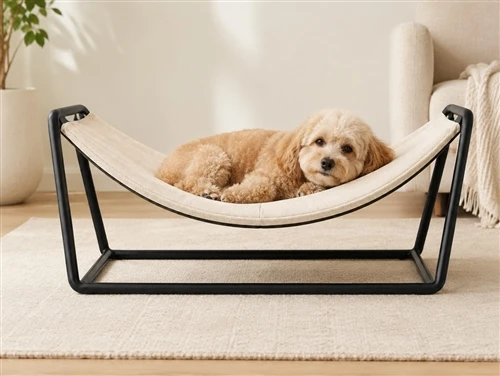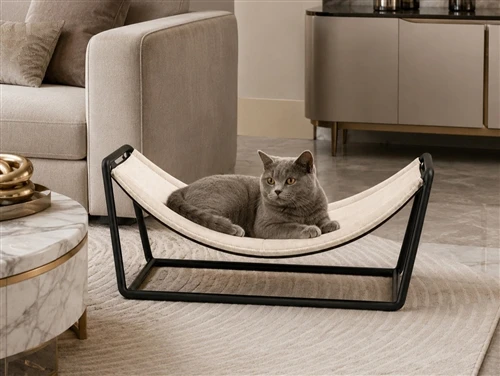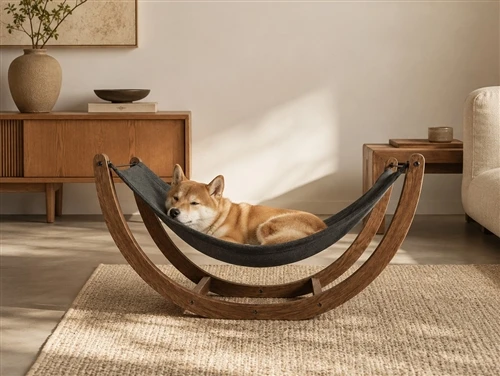
When buying pet furniture online, price is often a key factor in the purchase decision. Two seemingly similar products, one priced at $80 and the other at $200-many people's first reaction is, "Choose the cheaper one; it just needs to look similar." However, after six months to a year of use, those who chose the cheaper product may find that: the cat tree starts to loosen and wobble, the pet bed collapses and becomes unusable, and the rope posts are completely worn out.
Only then do they realize-the cheaper product didn't save money, because it needed to be replaced much earlier. Understanding the "hidden costs" in pet furniture can help you make more informed purchasing decisions.
I. Main Sources of Hidden Costs in Pet Furniture Short Lifespan of Filling Materials
Cheap pet beds use shredded sponge or low-density sponge (density below 22kg/m³), which begins to show significant sagging after 3-6 months of normal use; after 12-18 months, the fabric becomes loose and uneven, unable to provide effective support. High-quality memory foam or orthopedic foam, on the other hand, can last 5-8 years. While both provide a sleeping environment for pets, low-priced cat trees need to be replaced 2-3 times within 3 years, with the total cost exceeding the price of a one-time purchase of a high-quality product.
Insufficient Wood Strength – Low-priced cat trees use MDF or thin pine (less than 12mm thick). Under the impact of repeated jumping by cats, the platform may bend, crack, or even break within 6-12 months. High-quality solid wood cat trees (birch or beech, with a board thickness of 18mm or more) typically have a lifespan of 3-5 years or even longer.
Hardware Rusting and Failure – Low-priced products use ordinary iron screws and angle irons without rust-proof coatings. They begin to rust within 1-2 years in normal indoor environments. Rusting significantly reduces the strength of the connectors, rapidly deteriorating the overall structural stability. High-quality products use stainless steel or hot-dip galvanized hardware, which will not rust for years under normal use.
Undurable Fabric – Low-priced pet beds use low-density polyester fabric, which has poor abrasion resistance, is prone to pilling, and easily tears. Dogs prone to chewing may tear the cover within weeks. High-quality Oxford cloth or canvas bed covers are typically 3-5 times more durable than those made from cheaper materials.
Irreparable – Cheap cat trees are usually one-piece structures, and the rope posts cannot be replaced individually. Once the rope is worn out, the entire tree must be discarded. Modularly designed cat trees allow you to replace only the rope posts, costing only 1/5 to 1/3 of the cost of the entire product.
II. Calculating Real Costs Over a Three-Year Period
Scenario 1: Cheap Pet Bed, Price $30
Expected Lifespan: 12 months
Number of Purchases Required in Three Years: 3
Total Purchase Cost in Three Years: $90
Pet's Comfort Experience in Three Years: 12 months Comfortable → 12 months Average → 12 months Poor
Environmental Burden of Disposing of Old Beds: Waste from 3 Beds
Scenario 2: Mid-Range Pet Bed, Price $80
Expected Lifespan: 36 months
Number of Purchases Required in Three Years: 1
Total Purchase Cost in Three Years: $80
Pet's Comfort Experience in Three Years: 36 months Consistently Good
Environmental Burden of Disposing of an Old Bed: Waste from 1 Bed
Scenario 3: High-End Pet Bed (Orthopedic Memory Foam), Price: $160
Expected Lifespan: 72-96 months
Number of Purchases Required in Three Years: 1 Bed (Still Usable)
Total Purchase Cost in Three Years: $160 (But Can Be Used for 6-8 Years)
Pet's Comfort Experience in Three Years: Consistently Excellent for 36 Months
Data Analysis: Although low-priced beds have the lowest unit price in three years, the total expenditure of $90 over three years exceeds that of mid-range beds at $80, and the comfort and quality performance are far inferior to mid-range products. While high-end beds have the highest initial expenditure, their 8-year lifespan means an average annual cost of only $20-25/year, far lower than the $30/year of low-priced beds (and a better experience).
III. Why are low-priced products difficult to achieve "good value for money"?
The cost structure of pet furniture is roughly as follows:
Raw material costs (wood, foam, fabric, hardware) account for 50-60% of the total cost.
Production and processing costs (cutting, assembly, packaging, quality inspection) account for 20-25%.
Transportation and logistics costs account for 10-15%.
Marketing and channel costs account for 10-15%.
Brand and profit margin account for 5-15%.
When the final retail price of a product is only half that of similar products, it means that multiple aspects such as raw materials, production, and quality inspection have been compressed. Replacing wood with cheaper varieties, using lower-density foam, using thinner fabrics, using wrought iron instead of stainless steel for hardware, and simplifying or eliminating quality inspection processes-each item may seem "small" on its own, but cumulatively, the actual performance and lifespan of the product show a significant difference.
A simple business logic: No one can maintain the same quality while offering a price only half that of competitors. If the price is significantly lower than the market average, the product must have compromised in one or more aspects. The question is: will this compromise affect the safety and lifespan of the pet furniture?
IV. How to Determine a Product's "Long-Term Cost-Effectiveness"?
Check Material Specifications-Does the product clearly indicate the type of wood, board thickness, foam density, and fabric type? Manufacturers who clearly specify the materials are more confident in allowing consumers to inspect their products and are more motivated to maintain consistent quality standards.
Assess Repairability-Can the rope posts be replaced individually? Can the bed cover be purchased separately for replacement? Repairable products are significantly more economical in the long run, avoiding the waste of "if one post breaks, the whole set has to be thrown away."
Check Product Weight-Among similar products, a heavier cat tree usually means the use of thicker boards, thicker posts, and more metal parts, which also means greater stability and durability. Lightweight products often indicate cost-cutting in materials.
Read User Reviews-Focus on reviews after "6 months of use" and "1 year of use," rather than just looking at the initial five-star reviews. Long-term evaluation is a true reflection of a product's durability.
Inquire about Warranty Policies-Brands offering warranties of 1 year or more are more confident in their product quality.
V. Summary
The initial "savings" of inexpensive pet furniture are often an illusion. When it becomes loose, sagging, or broken after a year, you'll face a new purchasing decision-either buy another inexpensive product, falling into a cycle of "buy cheap → break down → buy cheap again," or, having already spent money once, buy a higher-quality product. Either way, the final total expenditure will be higher than buying a high-quality piece of furniture from the start.
The idea that "buying cheap saves money" is a concept that needs to be re-examined. In the pet furniture category-which concerns a pet's health, safety, and daily comfort, and has a lifespan of several years-choosing a truly durable product is often a more responsible decision for both your pet and your budget.